






Disclaimer: While we gave samxplogs a free BusKill Kit for review, we did not pay them nor restrict their impartiality and freedom to publish an independent review. We did require them to make the video open-source as a condition of receiving this free review unit. The above video is licensed CC BY-SA; you are free to redistribute it. If you are a video producer and would like a free BusKill Kit for review, please contact us
Want to see BusKill in-action? Checkout these video demos made by YouTuber @samxplogs showing the BusKill cable in-use on several supported platforms:
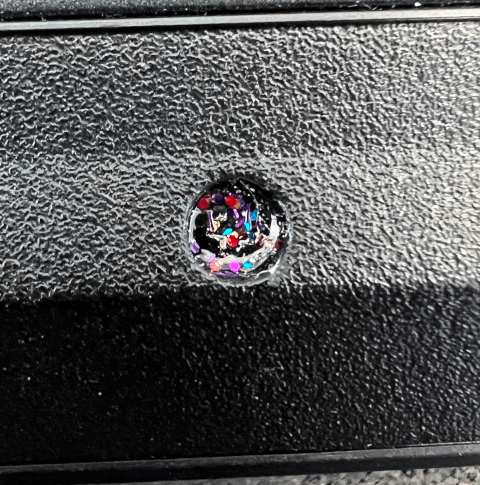
We don’t consider hologram stickers or tamper-evident tape/crisps/glitter to be sufficient solutions to supply-chain security. Rather, the solution to these attacks is to build open-source, easily inspectable hardware whose integrity can be validated without damaging the device and without sophisticated technology.
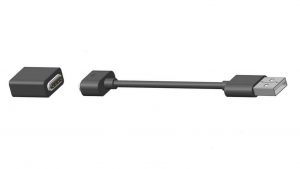
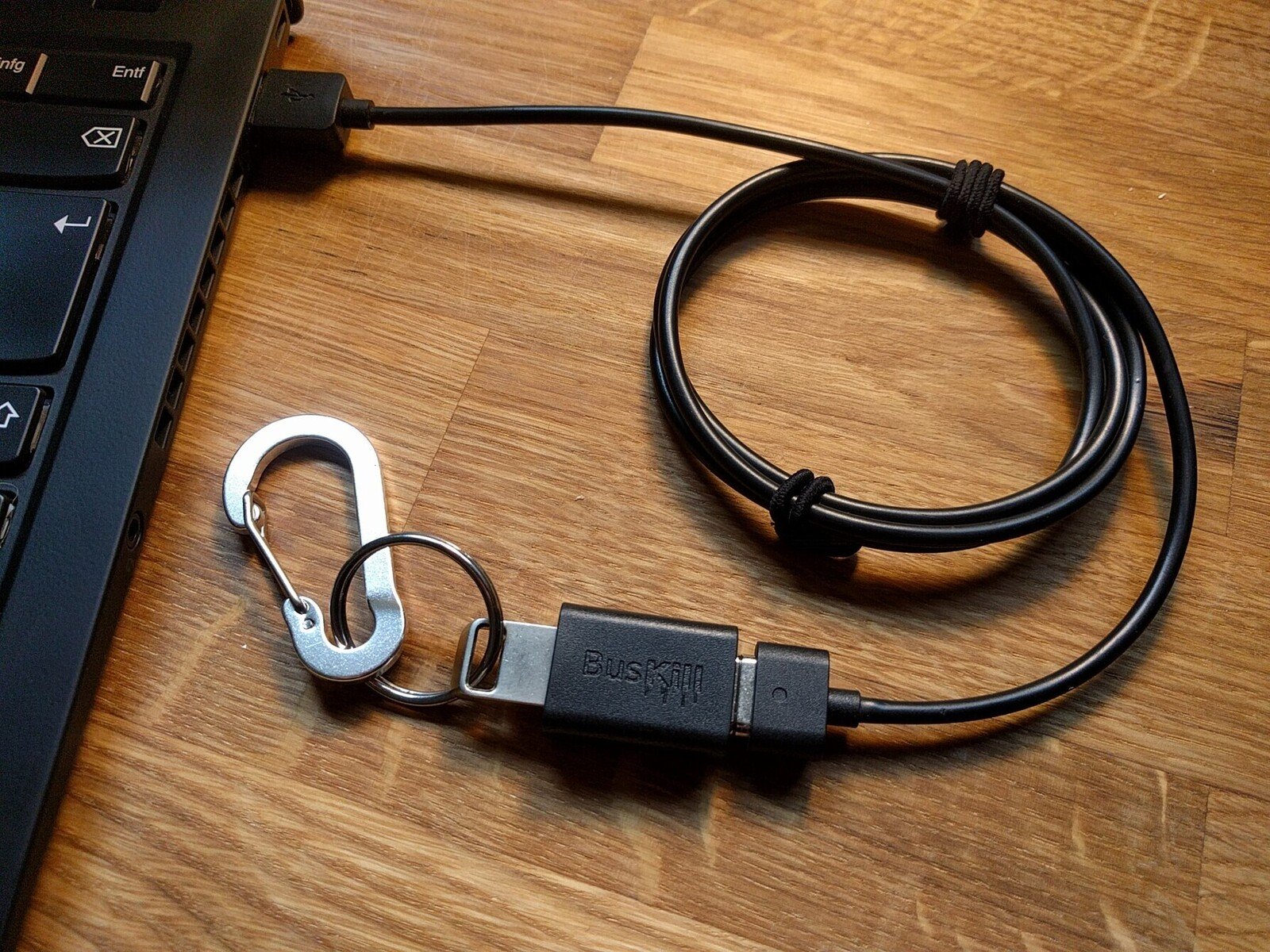
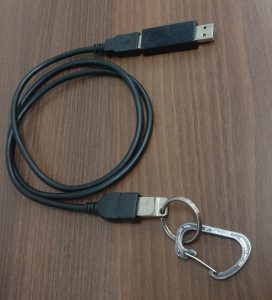
Actually, the best way to confirm the integrity of your hardware is to build it yourself. Fortunately, BusKill doesn’t have any circuit boards, microcontrollers, or silicon; it’s trivial to print your own BusKill cable — which is essentially a USB extension cable with a magnetic breakaway in the middle
Mitigating interdiction via 3D printing is one of many reasons that Melanie Allen has been diligently working on prototyping a 3D-printable BusKill cable this year. In this article, we hope to showcase her progress and provide you with some OpenSCAD and .stl files you can use to build your own version of the prototype, if you want to help us test and improve the design.
In our last update, I showed a video demo where I succesfully triggered a lockscreen using a BusKill prototype without the 3D-printed body for the case and N35 disc magnets. I realized that the N35 disc magnets were not strong enough. In this update, I show a demo with the prototype built inside a 3D-printed case and with (stronger) N42 and N52 cube magnets.
We don’t consider hologram stickers or tamper-evident tape/crisps/glitter to be sufficient solutions to supply-chain security. Rather, the solution to these attacks is to build open-source, disassembleable, and easily inspectable hardware whose integrity can be validated without damaging the device and without sophisticated technology.
Actually, the best way to confirm the integrity of your hardware is to build it yourself. Fortunately, printing your own circuit boards, microcontroller, or silicon has a steeper learning curve than a BusKill cable — which is essentially just a USB extension cable with a magnetic breakaway in the middle.
Mitigating interdiction via 3D printing is one of many reasons that Melanie Allen has been diligently working on prototyping a 3D-printable BusKill cable this year. In this article, we hope to showcase her progress and provide you some OpenSCAD and .stl files so you can experiment with building your own and help test and improve our designs.
We’re excited to announce that our first production run of BusKill cables is now in-stock in our distribution center. Existing orders are going out now, and new orders will ship immediately.
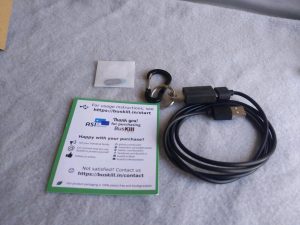
When the only USB-A magnetic breakaway coupler on the market became out of stock and EOL’d, we raised $18,507 on CrowdSupply in early 2022 to manufacture our own injection-molded cable. One thousand logistics challenges later, Mouser started shipping BusKill cables to our backers in October 2022.
Now that the hardware is out the door, we’re hard at work on new features for the BusKill app. Our top goal is to add a soft-shutdown trigger to the existing lock-screen trigger. At the time of writing, this is functional on Linux and Windows. We’re just working out the kinks of privilege escalation on MacOS.
To be notified when we’ve added the soft-shutdown trigger to the BusKill app, you can signup for our newsletter.
Sign up to receive email updates about BusKill
We did our best to test BusKill across the three target platforms, but the wide spread of OS versions does leave room for error. If you happen to find a bug with BusKill, please let us know.
If you don’t have a BusKill cable yet, you can buy one here on this website or build your own. And for the makers out there, checkout the progress on our 3D printable BusKill magnetic breakaway coupler 🙂
Transparency is important. As we launch our crowdfunding campaign (making the BusKill cable available for purchase for the first time), we wanted to provide a clear video demo showing the cable in-use in all tested platforms:
While you could use the BusKill Linux .AppImage release with a second USB drive while using TAILS, the recommended solution for security-critical users is to just use the BusKill cable in-line with the TAILS live USB drive. This takes advantage of
Due to the design of QubesOS (dom0, sys-usb, etc), the BusKill GUI app does not support QubesOS. Instead, QubesOS support is implemented using the qubes-rpc and a set of scripts stored in sys-usb and dom0.
This post will describe how to use BusKill as a dead man switch to trigger your laptop to self-destruct if it’s physically separated from you. This guide is specific to QubesOS users.
What if someone literally steals your laptop while you’re working with classified information inside a Whonix DispVM? They’d also be able to recover data from previous DispVMs–as Disposable VM’s rootfs virtual files are not securely shredded after your DispVM is destroyed.
Are you a security researcher, journalist, or intelligence operative that works in QubesOS–exploiting Qubes’ brilliant security-through-compartimentalization to keep your data safe? Do you make use of Whonix Disposable VMs for your work? Great! This post is for you.
I’m sure your QubesOS laptop has Full Disk Encryption and you’re using a strong passphrase. But what if someone literally steals your laptop while you’re working with classified information inside a Whonix DispVM? Not only will they get access to all of your AppVM’s private data and the currently-running Whonix DispVM’s data, but there’s a high chance they’d be able to recover data from previous DispVMs–as Disposable VM’s rootfs virtual files (volatile.img) are not securely shredded after your DispVM is destroyed by Qubes!
Let’s say you’re a journalist, activist, whistleblower, or a human rights worker in an oppressive regime. Or an intelligence operative behind enemy lines doing research or preparing a top-secret document behind a locked door. What do you do to protect your data, sources, or assets when the secret police suddenly batter down your door? How quickly can you actually act to shutdown your laptop and shred your RAM and/or FDE encryption keys?
BusKill utilizes a magnetic trip-wire that tethers your body to your laptop. If you suddenly jump to your feet or fall off your chair (in response to the battering ram crashing through your door) or your laptop is ripped off your table by a group of armed thugs, the data bus’ magnetic connection will be severed. This event causes a configurable trigger to execute.
This post will describe how to add a trigger that initiates a “self-destruct” sequence when your BusKill laptop kill cord’s connection is severed–rendering your data permanently & irrevocably destroyed in the event that your laptop were physically separated from you (ie: by a snach-and-run thief).
Many people were disappointed when the original post introducing BusKill only alluded to a self-destruct trigger, without actually describing how to use it with BusKill. This was done for two reasons:
Most people probably don’t actually want an accidental false-positive to destroy all their data and
A self-destruct sequence should be taken seriously. Its implementation should be thoroughly thought-out, tested, and forensically analyzed
This article will provide that thorough analysis and explain to the reader how to implement a self-destruct trigger with BusKill on linux machines that have FDE with LUKS.
Today, we’re happpy to announce that there’s a new way to browse our website more securely and anonymously. To do it, you’ll need a bit of software called the Tor Browser
Besides the obvious anonymity benefits–allowing our customers to purchase our products anonymously–we chose to make our website accessible at the above .onion address to take advantage of tor’s superior Public Key Infrastructure to the clearnet’s flawed x509 model (read: it’s more secure).
In short, users are much safer when communicating directly to a website using a .onion domain than its clearnet domain.
We’ve always made sure that our site’s content was fully accessible to Tor Browser on strict mode. Unlike other popular websites, we would never use Google reCAPTCHA or blanket block Tor exit nodes.
We want and encourage our customers to be able to use all of our services over Tor. And by adding our service over an Onion Service, our customers with a healthy distrust for the X.509 PKI can take comfort in knowing that accessing our website through our Onion Service address will give them end-to-end encryption using our Tor-generated certificate.
You can buy a BusKill cable with bitcoin, monero, and other altcoins directly from our BusKill Store’s Onion Site:
This post will introduce a simple udev rule and ~$20 in USB hardware that effectively implements a kill cord Dead Man Switch to trigger your machine to self-destruct in the event that you’re kicked out of the helm position.
ⓘ Note: This is an old article that is out-of-date.
Rubber Ducky I <3 you; you make hack time lots of fun!
Let’s consider a scenario: You’re at a public location (let’s say a cafe) while necessarily authenticated into some super important service (let’s say online banking). But what if–after you’ve carefully authenticated–someone snatch-and-runs with your laptop?
Maybe you can call your bank to freeze your accounts before they’ve done significant financial harm. Maybe you can’t.
Or maybe your laptop was connected to your work VPN. In less than 60 seconds and with the help of a rubber ducky, the thief could literally cause millions of dollars in damages to your organization.
Surely there must be some solution to trigger your computer to lock, shutdown, or self-destruct when it’s physically separated from you! There is: I call it BusKill.