



Featured Updates

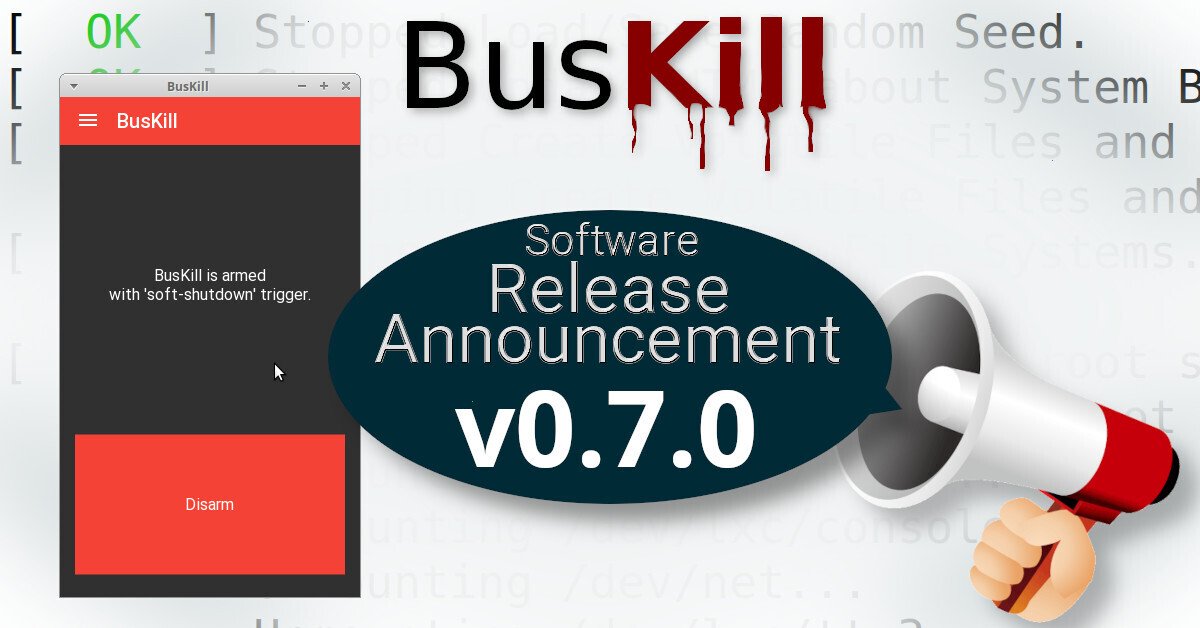
BusKill v0.7.0 released
previous arrow
next arrow

Techlore Interview (BusKill, Interdiction, and OpSec)

We’re super happy to share that Techlore invited BusKill founder Michael Altfield onto their YouTube channel to talk about BusKill, security, and privacy

In addition to answering questions about the origin of BusKill, the interview ran a gamut of issues regarding security and privacy — including

  1. How to mitigate State-sponsored interdiction attacks,
  2. minimizing attack surfaces of mobile phones with broadband processors,
  3. the threats of AI “identity verification” systems on privacy,
  4. and much more

You can watch the full video below

Can’t see video above? Watch it on PeerTube at tehlore.tv or on YouTube at youtu.be/cptk6aBbJpU

To see the full discussion about this video on PeerTube, see:

What is BusKill?

BusKill is a laptop kill-cord. It’s a USB cable with a magnetic breakaway that you attach to your body and connect to your computer.


If the connection between you to your computer is severed, then your device will lock, shutdown, or shred its encryption keys — thus keeping your encrypted data safe from thieves that steal your device.

Techlore Review

If you’d like to see Techlore’s review video of BusKill, you can find that here:
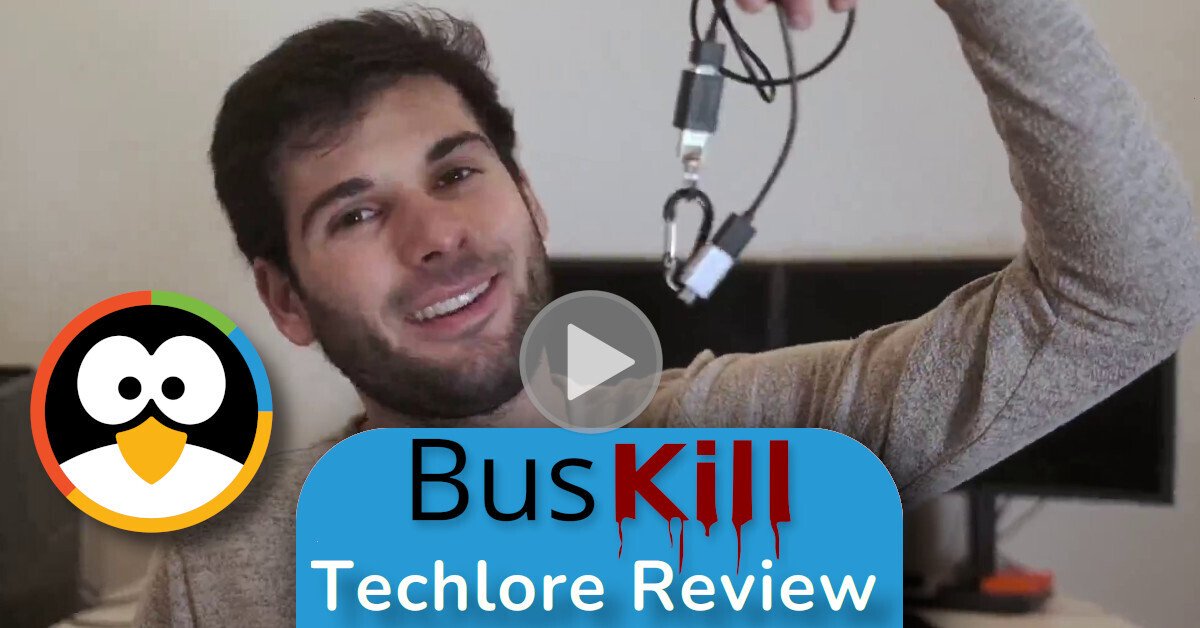
BusKill Techlore Review

Support BusKill

If you want to help our open-source project, please consider purchasing a BusKill cable for yourself or a loved one. It helps us fund further development, and you get your own BusKill cable to keep you or your loved ones safe.

You can also buy a BusKill cable with bitcoin, monero, and other altcoins from our BusKill Store’s .onion site


Bitcoin Accepted Here

Monero Accepted Here

To be notified about future updates, you can signup for our newsletter.


A Laptop Kill Cord for QubesOS

This post will describe how to use BusKill as a dead man switch to trigger your laptop to self-destruct if it’s physically separated from you. This guide is specific to QubesOS users.

What if someone literally steals your laptop while you’re working with classified information inside a Whonix DispVM? They’d also be able to recover data from previous DispVMs–as Disposable VM’s rootfs virtual files are not securely shredded after your DispVM is destroyed.

QubesOS Logo
QubesOS: A reasonably secure OS

This is part one of a two-part series. For part two, see Disarm BusKill in QubesOS (2/2)

  1. A Laptop Kill Cord for QubesOS (1/2)
  2. Disarm BusKill in QubesOS (2/2)

Are you a security researcher, journalist, or intelligence operative that works in QubesOS–exploiting Qubes’ brilliant security-through-compartimentalization to keep your data safe? Do you make use of Whonix Disposable VMs for your work? Great! This post is for you.

I’m sure your QubesOS laptop has Full Disk Encryption and you’re using a strong passphrase. But what if someone literally steals your laptop while you’re working with classified information inside a Whonix DispVM? Not only will they get access to all of your AppVM’s private data and the currently-running Whonix DispVM’s data, but there’s a high chance they’d be able to recover data from previous DispVMs–as Disposable VM’s rootfs virtual files (volatile.img) are not securely shredded after your DispVM is destroyed by Qubes!

Let’s say you’re a journalist, activist, whistleblower, or a human rights worker in an oppressive regime. Or an intelligence operative behind enemy lines doing research or preparing a top-secret document behind a locked door. What do you do to protect your data, sources, or assets when the secret police suddenly batter down your door? How quickly can you actually act to shutdown your laptop and shred your RAM and/or FDE encryption keys?


BusKill utilizes a magnetic trip-wire that tethers your body to your laptop. If you suddenly jump to your feet or fall off your chair (in response to the battering ram crashing through your door) or your laptop is ripped off your table by a group of armed thugs, the data bus’ magnetic connection will be severed. This event causes a configurable trigger to execute.

The BusKill trigger can be anything from:

  1. locking your screen or
  2. shutting down the computer or
  3. initiating a self-destruct sequence

This post will describe how to setup such a system in QubesOS with BusKill

Can’t see video above? Watch it on PeerTube or on YouTube at youtu.be/IQAO8u_JWUQ

Continue reading

LUKS Header Shredder (BusKill Self-Destruct Trigger)

This post will describe how to add a trigger that initiates a “self-destruct” sequence when your BusKill laptop kill cord’s connection is severed–rendering your data permanently & irrevocably destroyed in the event that your laptop were physically separated from you (ie: by a snach-and-run thief).

LUKS Header Shredder

Many people were disappointed when the original post introducing BusKill only alluded to a self-destruct trigger, without actually describing how to use it with BusKill. This was done for two reasons:

  1. Most people probably don’t actually want an accidental false-positive to destroy all their data and
     
  2. A self-destruct sequence should be taken seriously. Its implementation should be thoroughly thought-out, tested, and forensically analyzed

This article will provide that thorough analysis and explain to the reader how to implement a self-destruct trigger with BusKill on linux machines that have FDE with LUKS.

Can’t see video above? Watch it on PeerTube or on YouTube at youtu.be/WA8sL4236jM

Continue reading

Scroll to top